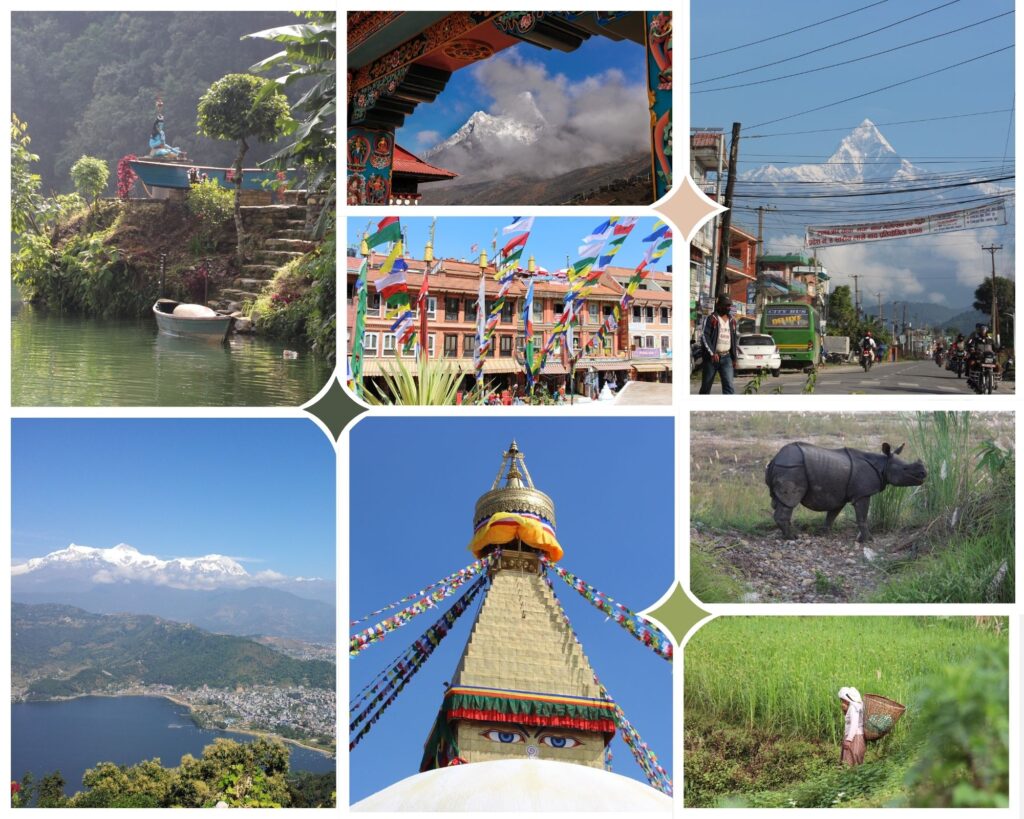



A journey between worlds. Encounters with open, warm-hearted people. Respect and joy towards tourists who see and appreciate the beauty of the country behind poverty and destruction. A country that has everything world explorers and adventurers could wish for.
temple
When Rustham takes his guests on a tour of "his" city, he always brings an umbrella. "The monsoon is just coming to an end," he grins, "so you never know." Anyone who has experienced their first monsoon rain knows that a classic German rain jacket is virtually useless. Within seconds, the streets are flooded and the raindrops seem to come from all directions. But today it's hot in Kathmandu. The air is stagnant in the valley basin, and the smog from the exhaust fumes of countless mopeds, old cars, and rickety trucks hangs like a cheese cover over the capital of Nepal. By now, many are wondering why they should spend part of their vacation here of all places. But Kathmandu is unique, just like the rest of the country. It is a melting pot of religions, cultures, and people.
It's not the first time I've arrived here. As we approach the city, we are treated to a sensational view of the green hills of the valley, with the snow-capped peaks of the 8,000-meter mountains visible on the distant horizon. A rainbow stretches across the rooftops, seeming to be a sign of welcome and a glimmer of hope for those arriving. Tourists in trekking gear from the West and locals who work in the Emirates to support their families living here stream out of the plane. Rustham is already waiting for us, draping the obligatory white scarf "for a good journey" around our necks.
This city is loud, chaotic, and dirty. And yet it exudes a latent charm, an appeal that hardly any visitor to Kathmandu can resist. Newcomers to one of Asia's poorest countries may well be in shock for the first few minutes. I, on the other hand, revel in the impressions offered to me at the roadside: peddlers with decrepit bicycles offer bananas by the kilo, rickshaw drivers vie for customers, a colorful mix of brightly dressed women, monks in red robes, and children in school uniforms pass by. In the distance, I recognize Swayambunaht, one of the most important Buddhist stupas, located on a hill in the middle of the city.
Like almost all tourists, we stay in Thamel, the bustling business district. The alleys are narrow, with vendors selling knitwear, trekking equipment, teas, silk scarves, and handicrafts. I love this hustle and bustle, the open-minded people, and the crowded alleys. Strolling through this maze, you forget the time. It is a small, lively and twisted world unto itself that presents itself to visitors here. As a self-confessed Kathmandu fan, I naturally end up at Pilgrim's – probably the most exciting and famous bookstore in the world – and drink my Italian cappuccino in the German bakery. To enjoy lassi, a yogurt drink, we drive to Bakthapur, where the Tibetan Cafe with a view over the lively Durbar Square is said to serve the best. Alongside Patan, this suburb of the capital is one of the country's most famous cultural monuments.
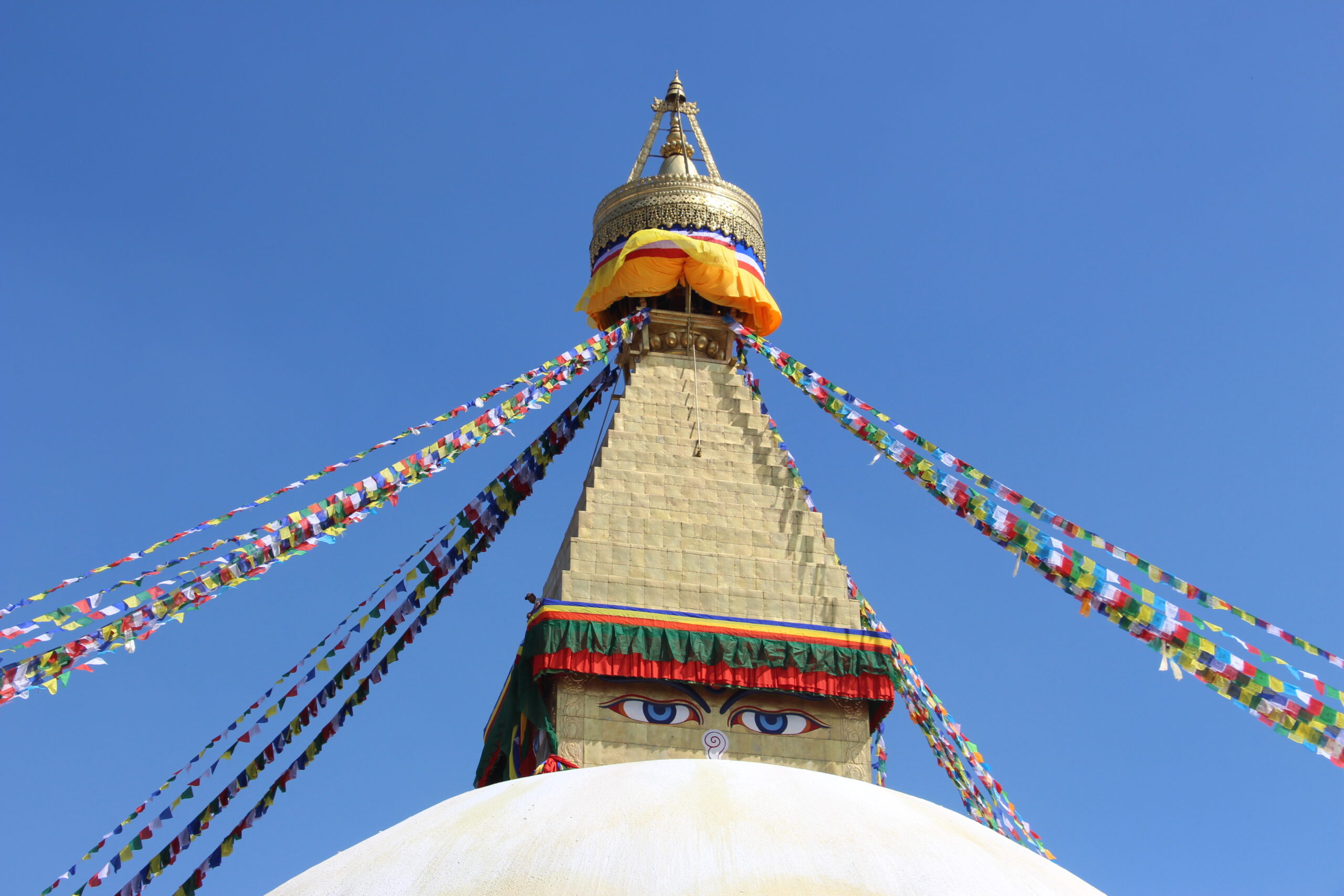
Smoke billows in the air. At the edge of the ... the bodies, covered with cloths and decorated with flowers, are burned on large pyres. The whole family gathers for this ritual. For the observer, the ritual in Pashabunath is a mixture of fascination and revulsion. On the way to the temples, I buy a necklace made of Rudraksha seeds. It is said to ward off illness and bring good luck. On Swayambunath Hill, monkeys are playing and waiting for an opportunity to steal something to eat. Vendors try to sell prayer wheels, singing bowls, and bracelets with Buddha's eyes, and between believers, tourists, and begging women with babies in their arms, the view of the city becomes clear again and again. But my favorite place is Bodnath. The most famous stupa symbolizes the country like no other place. Even the first steps around the imposing ... put me in an almost meditative mood. The scent of incense sticks mingles with the murmurs of praying monks from the monastery, hundreds of prayer flags flutter in the wind, and "Om mani padme om" – the mantra without which nothing seems to work in Nepal – echoes from the countless small shops. The meditative chanting sticks in your mind and accompanies you as you walk around the stupa, always clockwise. The eyes of Buddha are omnipresent, following you wherever you stand. At some point, you no longer know where the beginning and the end are. "The infinite loop," Rustam would say. The signs of Buddhism never leave you in this country – whether you want them to or not.
trekking
Rain. Rain from above, from the side, and from below? However, what came from the ground were not raindrops, but rather cute little leeches, as our trekking guide said with a laugh, helping us to remove the bloodsuckers. "They come with the rain." After a short time, my originally white hiking socks were covered with bloodstains. By now, at the latest, you know why your pants should be tucked into your socks. Slowly, we make our way uphill through the steamy, blooming, pristine rainforest. Soon, it's impossible to tell whether the wetness comes from sweat due to the exertion or the endless rain. But eventually, we reach the village. The streets are deserted. A cheerful Nepalese woman waves us into her small guesthouse. On the porch, covered with plastic sheeting, she serves us hot chai, visibly amused by the hiking-mad tourists in rain capes, dripping wet and yet full of motivation to discover the magnificent Annapurna Range on foot. At this moment, you can't imagine anything better!
Arrival at Basanta Lodge. A few tentative rays of sunshine pierce through the clouds, a blue ribbon pushes its way through and clears the view. This fabulous view of the entire Annapurna Range. It is a sight that takes your breath away. The infinite dignity and power of these highest mountains on earth leave us speechless. While we sweat in the subtropical climate, the peaks trapped in eternal ice and snow appear like messengers from another world.
tiger
The road winds through a narrow valley. On one side, it is bordered by high rock faces over which water flows; on the other side, there is a deep gorge through which the Narayani river winds. It is the main traffic artery to India. Colorfully decorated trucks, flatbed trucks with goats, buses full of people, and us in between. Close to the slope are primitive wooden shacks where dhal and momos are offered to travelers on open fires. In between, small children jump around – a nightmare for our German welfare mindset. In adventurous overtaking maneuvers, our sensationally talented young driver tries to get ahead a little faster – but ultimately, it doesn't really work. Patience and composure are required here. But eventually we overcome this, leave the valley behind us, and finally reach Chitwan National Park.
To cut a long story short: we didn't see any tigers – just a fresh paw print on the muddy path. But we discovered much more in this very unspoiled and little-visited national park. Asian rhinos, sluggish crocodiles, bathing elephants (who enjoy giving us a shower too) and an enchanting landscape that, like the sluggishly flowing river, determines the pace and mentality of life and the people here.
There is so much I could write about this wild and serene, beautiful and challenging country. About Manaslu, which towers like a mighty guardian over the small mountain town of Gorkha. About Pokhara, this cozy little town on Lake Phewa, which is full of adventure seekers from all over the world, about the magnificent Annapurna massif, which provides sensational views every day. About many little incidents along the way. And about people who live here with conviction despite all adversities.
In Nepal, you experience a rollercoaster of emotions. Between enthusiasm and self-consciousness, humility and fascination, this small country nestled among the highest mountains on earth has once again managed to captivate me. And it certainly won't be the last time.
©Susanne Pinn