



One of the last indigenous peoples on Earth lives on the jungle-covered banks of the rivers of Sarawak: the headhunters of the Iban tribe. But how wild are these savages really? To find out, you have to embark on an adventurous journey to the northwest of the island of Borneo.
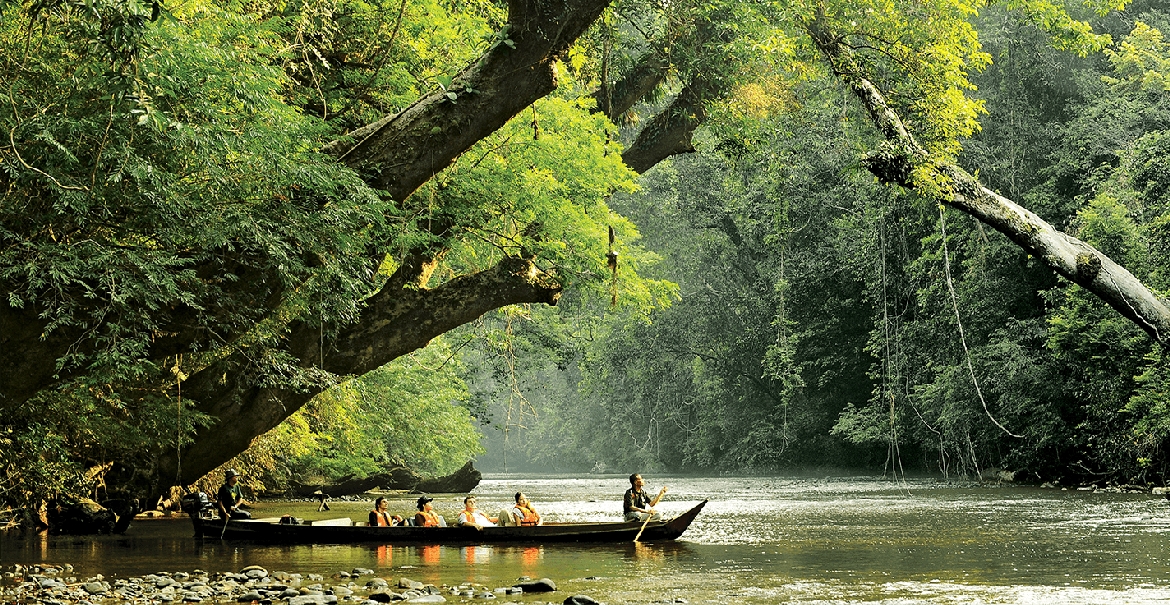
The jungle is steaming. The air is hot and humid, making it difficult to breathe. The longboat glides quietly across the river. Only the wind provides a little cooling. The eyes of a small crocodile flash in the embankment. It disappears silently between the mangrove roots. The roar of the diesel engine combines with the shrill chirping of the cicadas to create a dense soundscape, similar to the impenetrable thicket at the edge of the bank. A hornbill with its characteristic curved beak swoops over the water. Together with the musty smell emanating from the jungle that reaches the banks, the whole atmosphere is a challenge for the senses.
Here, in the Malaysian part of Borneo, the headhunters of Sarawak live in the last untouched areas of the tropical rainforest. Two travelers from Holland sit with me in a prau, as the natives call their only means of transportation. Our journey takes us upriver to a small settlement of the Iban tribe. Forty-year-old Paul Mathew, our small group's tour guide, is a member of the tribe. Tall, strong, and with a permanent grin on his caramel-colored face, he has been accompanying adventurous tourists to the most remote areas of Malaysia for ten years. No movement escapes him in the green tangle that draws together like a roof above us in the narrow sections of the river. It seems as if this natural tunnel leads the way to a completely different world.
The Iban, also known as Sea Dayak, make up 30 percent of the total population of Malaysian Borneo and live mainly along the rivers of Sarawak. Just 70 years ago, foreign intruders would have had to fear for their lives. After all, the savages were considered headhunters. In the 19th century, this led to violent conflicts with European colonial powers, especially with the British adventurer James Brook, who became known as the "White Rajah" and Sultan of Sarawak. He put an end to headhunting by having the hunters themselves beheaded. By the end of the 19th century, brutal decapitation was considered to have been completely abolished. Nevertheless, a few last Japanese skulls rolled during World War II. Today, guests are welcomed more warmly.
After a two-hour drive from the small village of Lubuk Subong, a naja, or longhouse, comes into view. Thirty Iban families live here together under one roof. Numerous doors lead from the ruai, a kind of veranda, to the families' living quarters. Once your eyes have adjusted to the dim light, your gaze is drawn to the objects dangling from the ceiling. Carved shrunken heads with straw hair, blowguns, woven baskets, necklaces made of all kinds of dried berries, machetes, and pointed hats bear witness to spirit conjuring and ancient traditions. But the fascination with these testimonies to old customs disappears when suddenly confronted with one's own Western world. Postcards from all over the world adorn the walls alongside photos of movie stars, famous soccer players, and even the Pope. An Adidas shirt with the Bayern Munich logo hangs next to a traditional Pua Kumbu, a type of wrap skirt, while chainsaws dangle from the ceiling with broad axes.
Small, with bronze-colored skin, jet-black hair, and angular cheekbones, the residents now stream out of all the doors. Cinta Kanyan, the wife of the tribal chief, serves tea. Things quiet down when her husband, the tuai rumah, appears. Alo Kanyan, barely five feet tall, slim and wiry, dressed in a blue tracksuit, a cigarette in the corner of his mouth, sits down calmly on the floor in a cross-legged position. The tattoos on his neck and arms, which mark him as a powerful man, have become unrecognizable on his wrinkled skin. The head of the community is consulted on all important family matters. He mediates disputes and manages food and everyday goods. In an attempt to create a kind of administrative system among the Iban, James Brook had already strengthened the position of chief to such an extent that he acted as a mediator between the tribe and the government of Sarawak. Even today, the tuai rumah still has a seat in parliament.
Paul translates the friendly words of welcome, and we are served tuak, a strong homemade rice wine, generously poured into plastic cups. In fact, the Iban seem to be very good drinkers as we soon stagger into the prepared camp at the other end of the veranda. With a mattress on the floor and a thin fabric hung up to serve as mosquito protection, our hosts have made us as comfortable as possible.
The nighttime sounds of the rainforest penetrate the thin wooden walls. The lazy morning, celebrated by the Iban with a first tuak and a cigarette, gives way to bustling activity around noon: nets are mended, baskets woven, the generator oiled—everyone has their task, which they perform with typical Iban serenity.
The downpour comes suddenly. It pelts down on the corrugated iron roof like a drum roll, making conversation impossible. For the people here, daily cloudbursts are part of everyday life. Wearing large round pointed hats, a group of women come laughing and dripping wet from the jetty. They carry long bamboo poles up to twenty centimeters thick on their backs. "Makai, makai," they call out cheerfully when they see the questioning looks. A term that stands for food, eating, and cooking at the same time. Just as quickly as it came, the rain is over. Sultry air rises from the jungle as if from a steaming cooking pot. While some men light a fire near the river, the women carry bowls of rice and raw meat. Both are pressed into the tubes, the rest is wrapped tightly in large bamboo leaves and placed directly into the fire. No one is in a hurry here. And we, too, are now moving with a certain sluggishness. With this gentle, low-fat diet, it's no wonder that the Iban enjoy a long life. "Besides, we have Tongkat Ali!" says Paul. The red berries of this plant are not only stimulating for mental and physical well-being, but also a natural Viagra. The older men nod with a wink, while the young ones bump each other and giggle.
The evening ritual on the veranda shows how deeply rooted the tribe is in ancient traditions and values. The sound of a gong and a xylophone form a monotonous melody. The Iban regularly pray to the gods for a good harvest in this way. A young man stands up and moves to the music in a stooped posture and stomping steps. He is covered only by a loincloth and an embroidered vest. Long feathers attached to a headband sit on his head. A girl in colorful traditional dress, adorned with countless jingling coins, joins him. The constant drumming, the smooth movements of the dancers, and the smoke-filled air also put the audience into a trance-like state. The fact that traditional dances are now performed more for tourists than for the spirits does not diminish the magic of the moment. A loud "Ooha" abruptly interrupts the mood. The Iban drinking toast heralds another long evening of tuak by the bottle.
Alo Kanyan sits on the jetty and gazes at the river. His cigarette glows in the dark night. Laughter and singing from the longhouse mingle with the lapping of the waves and the call of the cicadas. A bat glides over the water. The speech to the guests has been given, the gifts distributed. This is his life. Tomorrow, the visitors from another world will leave again.
The wild people are no longer as wild as they once were. They warmly welcome guests and willingly offer them a glimpse into their lives. In the few days we spend here, they make us feel like we belong. And even though the signs of Western influence can no longer be overlooked, the magic of the place remains unbroken.
©Susanne Pinn