



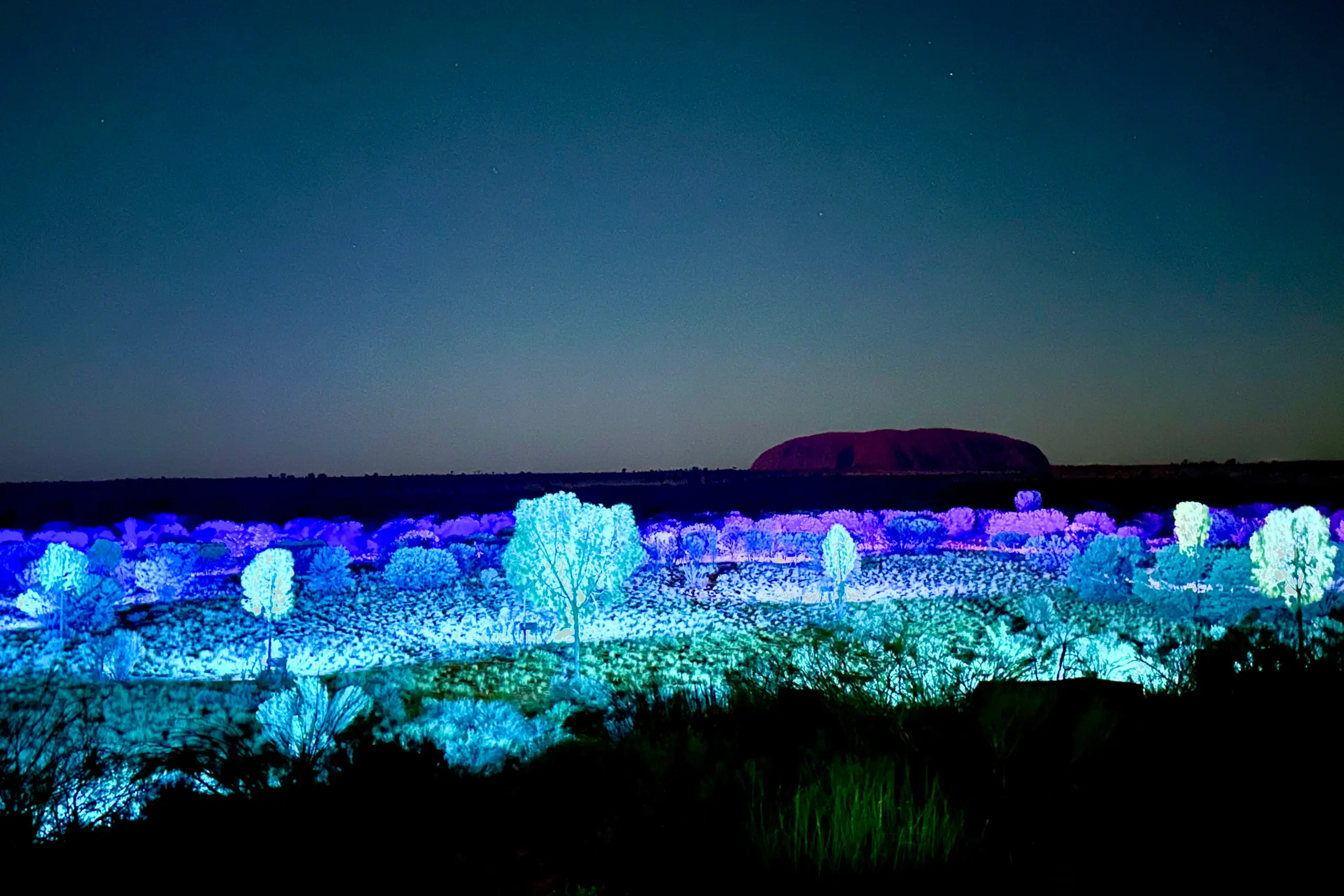
Wintjiri Wiru, the "beautiful view of the horizon." A new cultural STORYTELLING experience not only illuminates Uluru every night.
Slowly, the sun sinks behind the Kata Tjutas, leaving the "many hills" black against the glowing sky and bathing Uluru in a pastel-colored watercolor. A spectacle of light that only nature itself can create reveals the magic of the Red Center, inspiring awe at the incredible power of this unique land. Here, in Uluru-Kata Tjuta National Park, the land is sacred to the Anangu people and holds the secrets of the creation stories of this tribe, known as Tjukurpa ( pronounced chook-orr-pa), which form the basis of Anangu culture and connect the Yankunvtiatiara and Pitjantjatjara with the land and their ancestors. These stories contain important lessons about survival, relationships, and rules of behavior, as well as the origins of the universe.
Passed down orally for generations, there are no written records of Tjukurpa. The Anangu only share Tjukurpa with people they trust.
A new era
With the creation of Wintjiri Wiru in May this year, visitors have the opportunity to experience a Tjukurpa story firsthand for the first time. Uluru's newest attraction is also its most culturally significant, as it tells a chapter of the ancient Mala story from Kaltukatjara to Uluru. Wintjiri Wiru, the "beautiful view of the horizon," is not only the world's largest permanent drone and laser show, but also the first time an Indigenous story has been told using light, lasers, projection, and drone technology. The idea for Wintjiri Wiru came from the imagination of light artist Bruce Ramus. He wanted to bring the Mala story to visitors to Uluru in a new, unprecedented and sensitive way. A collaboration with senior Anangu from Kaltukatjara and Mutitjulu was established to ensure the legends were accurately reproduced. For Ramus, listening was at the heart of the entire creative process. For him, it was about "understanding from the heart.". Only in this way could he choose a technology that would accompany the stories while leaving the environment in its original state. "The technology was completely secondary to the main reason for being allowed to tell this story," says the artist.
Ramus and Voyages Indigenous Tourism spent three years developing Wintjiri Wiru together with the elders. The result is an extraordinarily complex and deeply moving work.
A special kind of evening
When we arrive for the three-hour Wintjiri Wiru Sunset Dinner Experience, we are immediately greeted with evidence of the care with which the land is respected here: a floating path made of recycled ironbark protects the flora and fauna below and leads between clumps of spinifex and mulga bushes to a small hill. The welcome of a spicy apple and koala gin aperitif, combined with the magical colors of the setting sun, provides the first sensory delight of the evening. The pure elation evoked by a 360-degree sunset at Uluru is indescribable. A carefully crafted culinary experience, curated by chef and indigenous culinary expert Mark Olive, further tantalizes the taste buds: Canapés with cucumber, gin, and green ants, crocodile curry cake with lemon myrtle, or blackened mountain pepper beef fillet on truffle slider brioche combine modern cuisine with local ingredients. These are accompanied by a fine selection of various local wines.
With a basket full of other delicacies, we finally take our seats in the open-air theater. As darkness envelops the desert, lasers and drones begin to tell the legends of the Mala people—the tribe of the "reddish rabbit wallabies." The story unfolds to gentle sounds, building momentum with ever-changing elements, explosions of light and color that become one with the endless landscape. The devil dog Kurpany, whose footprints are embedded in Uluru, is impossible to miss.
Our expectations of the show are completely exceeded – even though the use of drones is suspended due to strong winds. With lights, lasers, projections, and surround sound, the choreography of the 1,100 figures gives you goosebumps. For Rene Kulitia of the Ananagu Working Group, this is a new way to bring the history of his people to life: "People come from all over to see Uluru. We want visitors to know that this is our history. We want them to see, hear, and feel with us. It is the 'voices of the old people' that resound at Wintjiri Wiru and create an indescribable feeling in this moving show."
Wintiri Wiru sets the standard for how First Nations legends can be told correctly and tourism gently promoted in these deeply spiritual places. "We always welcome people who come to Uluru with open arms," says Kulitia. "We are one world, and we want to share something special with you. Wintjiri Wiru is our gift to everyone."
©Susanne Pinn